Do you know all the eight technical parameters of hydraulic cyclone?
2022/11/30

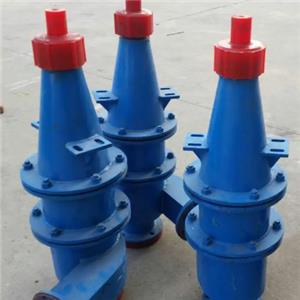
Hydraulic cyclone is an effective separation device for separating two-phase fluids using a centrifugal force field. It is a non-motion separation device composed of two parts: the upper cylinder and the lower cone.
The principle is that after the ore slurry is injected into the cylinder from the ore feeding tube in a tangent, involute or spiral line, the mixture of medium and particles rotates to form a centrifugal force field. Particles (or liquid phases) of different particle sizes and density produce different motion trajectories. Under the action of centrifugal force, medium resistance and isoform field, coarse particles and large-density particles move to the periphery and discharged from the sand sinking port through a cone; fine particles and low-density particles (or liquid phases) move to the center and discharged from the overflow pipe, ultimately realizing the coarse and fine grading of solid particles and the separation of fluids of different density.
In the practice of ore dressing, hydraulic cyclones are mainly used for graded operations in grinding circuits, especially in graded operations of fine grinding; ore can also be desilted and concentrated for sorting operations.
Different uses naturally put forward different requirements for the technical parameters of hydraulic cyclones, including structural parameters, process operating parameters, feed properties, etc., and each technical parameter is often related to each other, restricts each other, and is difficult to adjust and control. This requires us to be clear about each technical parameters before selecting a hydraulic cyclone and make targeted choices.
01
— Cylindrical cylinder diameter and height —
The diameter of the cylindrical cylinder is the main standard for distinguishing the size specifications of hydraulic cyclones, and has a certain proportional relationship with the sizes of other components. Increasing the diameter of the cylindrical cylinder can improve the handling capacity of the hydraulic cyclone, but at the same time the overflow particle size will become thicker and vice versa. When processing fine-grained materials and the processing volume is relatively large, we can use the method of connecting multiple small cyclones in parallel to form groups.
The height of the cylindrical cylinder has a significant impact on the residence time and grading efficiency of the ore slurry in the cyclone. When the depth of the overflow tube is inserted is fixed, increasing the cylinder height will extend the separation time, reducing the separation particle size and improving the separation efficiency, but it also has the negative effect of reducing the yield and increasing energy consumption. When reducing the cylinder height, the opposite result will be obtained. Generally, when the height of the cylindrical cylinder is 0.6-1.0 times the diameter of the cylindrical cylinder, the effect is better.
02
— The diameter of the ore feed port —
Generally, the diameter of the ore feed port is 0.13-0.25 times the diameter of the cyclone. Appropriately increasing the diameter of the ore feed port can increase the processing volume of the cyclone, but at the same time the grading efficiency will be reduced. Generally, the cross-sectional shapes of the hydrocyclone ore feeding pipe are mostly circular and rectangular, and are mostly rectangular. Their configuration is mostly parallel to the cyclone axis and the short side is perpendicular to the cyclone axis.
The structural form of the early ore feeding pipes and the through-through mode with the cylinder were mostly tangential. The advantages are that they are simple in structure and convenient in configuration, but the flow pattern changes suddenly, and the resistance loss along the route is large, which is easy to cause turbulence. Later, involute linear ore feeding pipes were widely used, which had the effect of reducing energy consumption, increasing production capacity and improving separation efficiency.
03
— Overflow pipe diameter —
Overflow tubes are mostly circular, and their diameter is usually 0.2-0.3 times the diameter of the hydraulic cyclone. Its main function is to lead the separated overflow product out of the body smoothly, constantly and continuously. When the diameter of the overflow tube is increased, the overflow volume will increase, but the overflow particle size will also become coarse, and the fine particles in the sand will decrease and the concentration will increase.
04
— Diameter of sand sinking mouth —
Generally, the diameter of the sand sinking mouth increases, the overflow amount decreases, and the overflow fineness becomes thinner, while the sand sinking amount increases, the concentration becomes lower, and the fineness increases. However, it has no significant impact on the processing volume of the cyclone. The diameter of the sand sinking mouth becomes smaller, and the sand sinking discharge is reduced. A "coarse" phenomenon will occur during the overflow. If it is too small, the coarse particles will accumulate more and more on the top of the cone, resulting in blockage.
Generally speaking, the diameter of the sand sinking mouth should ensure that the sand sinking is discharged in an umbrella shape, and the angle between 20° and 30° is ideal. The diameter of the sand sinking mouth is usually 0.07-0.1 times the diameter of the overflow pipe.
05
— The depth of the overflow tube insertion —
If the overflow tube is inserted too shallowly, the short-circuit flow rate will increase, the separation time will shorten, the coarse-grained grade content in the overflow product will increase, and the fine-grained grade content in the sand deposition product will decrease; if the overflow tube is inserted too deep, the coarse-grained grade at the bottom will enter the overflow, reducing the classification efficiency of the hydraulic cyclone. Generally speaking, the depth of the overflow tube should be 0.5-0.8 times the height of the cylindrical cylinder.
06
— The cone angle of the cylindrical cylinder —
Increasing the cone angle of the cylindrical cylinder will reduce the height of the cyclone and increase the average radial flow rate of the ore slurry. At the same time, due to the increase in the flow blocking effect of the cone, the upward flow rate of the ore slurry will also increase, resulting in the overflow particle size becoming coarser. Therefore, when separating coarse-grained particles, it is recommended to use a large cone angle (30°-60°); when separating fine-grained particles, it is recommended to use a small cone angle (15°-30°); when desilting, a smaller cone angle (10°-15°).
07
—Mine supply pressure —
The ore feeding pressure has a direct impact on the cyclone processing volume and separation particle size. Generally, the ore feed pressure should be maintained at 49-157kPa. Increasing the ore feeding pressure can reduce the grading particle size and increase the processing volume, but it can also significantly increase power consumption and cyclone wear. When working normally, the ore feeding pressure of the hydraulic cyclone should be maintained at a stable value.
08
— Pulse properties —
The properties of slurry mainly include density, particle size and slurry concentration. Under the same slurry concentration, the greater the ore density, the finer the graded particle size.
When the slurry concentration is large and the slurry content is high, the viscosity and density of the slurry will also increase accordingly, which increases the movement resistance of the particle size and makes the grading particle size coarse. vice versa. The ideal slurry concentration should be determined by ore dressing tests based on the specific production conditions.
From the above, it can be seen that during the use of the cyclone, the operator of the hydraulic cyclone can adjust the operation in a timely manner by adjusting the slurry pressure, changing the diameter of the sand deposition mouth, the slurry concentration, the cone angle, the size of the ore feeding pipe and the overflow pipe and the composition of the material particle size.
In addition, when choosing a hydraulic cyclone, it is recommended to purchase it from a professional and regular cyclone manufacturer. Based on its own actual production situation, consult professional cyclone technicians to strive to achieve a win-win situation of technical indicators and economic benefits.

Anhui Huawei Mineral Equipment Co., Ltd All rights reserved Anhui ICP No. 11018800Disclaimer